Second Acts, Second Chances, Second Comings
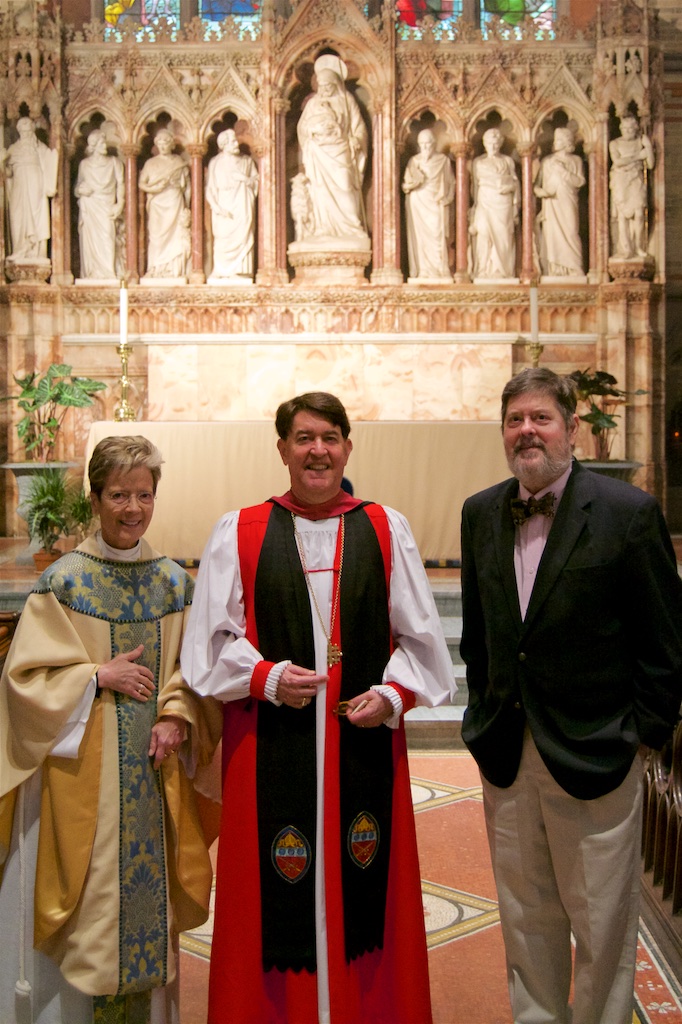
Bishop Franklin spent Ascension Day in New York City. The Bishop preached at the chapel of General Theological Seminary and at St. Mary the Virgin Church.
In his sermon at General Seminary, the Bishop preached on the topic of second acts, second chances and second comings.
The Bishop said, in part:
“There are two images [of the Ascension] that I particularly like.
One shows the hands of God around Jesus’s head, indicating that the Father was welcoming the Son into heaven.
The other is the “disappearing feet” image. You can still see this today half a block away from us, on Tenth Avenue, right next to the Highline, above the door of Guardian Angels Chapel. The crowds witnessing the Ascension look up to see Jesus’s feet disappearing at the top of the frame. It’s a simple but effective — and actually quite sophisticated — way of indicating that Jesus is literally out of the picture.
He is no longer here, bodily, on earth, limited to one place or one time. Now we recognize him as king of kings and lord of lords, seated in glory at the right hand of the Father, and accessible everywhere, all the time, to everyone.
Our scriptures do not place Mary the mother of Jesus among the followers watching the Ascension, but images of the Ascension traditionally do. Mary was, literally, there at the conception; she witnessed her son’s passion and death; and now she shares the joy and glory of his ascension. It is a second chance for her as she moves from grief to joy, from pain to pride, from the promise at the Annunciation that she would give birth to the Son of God to the undeniable evidence that this is so. Here is faith that survives the worst that the world can do.
The Easter story — from resurrection to ascension to Pentecost — is a story of second chances and do-overs, of forgiveness and reconciliation, of “Why not?” rather than “Why?”
The two major figures of this period — Peter and Paul — are people in whom God saw not failure but promise, people whom God would not throw away even though they had sinned mightily.
God transformed Saul, an enemy, into Paul, an advocate. He turned a threat of death into a promise of new life, a bully who demanded “Why?” into a leader who asked, “Why not?”
In Peter, the broken and damaged disciple —“Lyin’ Peter”— who betrayed Jesus became a healed and strengthened leader, no longer the impulsive upstart who tended to speak first and think later. Peter has his moment of truth. He is ready for his second chance, for whatever it brings. He is ready to ask, “Why not?”
This is a time of second acts and second chances in our nation and in the church.
In this presidential election year we have watched the campaigns and wonder what our next act as a nation is going to look like. I hope the “New York values” of diversity, inclusion, creativity and tenacity and welcome to all will be part of that next act for our Nation and for The Episcopal Church . After the primary on Tuesday, some of the unsuccessful candidates may be wondering what their own second chances are going to be.
We are called by our Presiding Bishop to be part of the Jesus Movement, which is as ancient as the first century and as new as today. We are called to ask,“Why not?”
- Why not a city in which people do not sleep on the streets or beg for change on the corner.
- Why not a nation in which children do not go to bed hungry.
- Why not a world in which health care, jobs and education are rights, not privileges.
- Why not a church focused on reconciliation and evangelism, transforming a nightmare into God’s dream.
My colleague N.T. Wright, the former Bishop of Durham, puts it this way: “The Church must be prepared to be the agent of healing even for those…who are the lepers of modern society. The Church must do for the world what Jesus did for the world: announcing the kingdom, healing the wounds of the world, challenging the power structures that keep anger and pain in circulation.”
Remember those images of the Ascension that I described a few minutes ago — the hands of God receiving Jesus into heaven, the feet of Jesus leaving the earth.
They remind us of the words of Teresa of Avila. ‘Christ has no body but yours, No hands or feet on earth but yours. Yours are the feet with which he walks to do good. Yours are the hands with which he blesses all the world.‘”
Recent News

Information on Ramon Aymerich
The Buffalo News reported this morning that the Diocese of Buffalo has added the name of an Episcopal priest with ties to the Diocese of Western New York to its …Read More »
Experimenting with Prayer Ministry at St. David’s, West Seneca
Bishop Sean is often heard to say that Episcopalians need to experiment for the sake of the gospel. Last month, St. David’s in West Seneca did just that when its …Read More »Pre-Convention Meetings in October
Members of both the Dioceses of Western New York and Northwestern Pennsylvania are invited to attend one of four joint pre-convention gatherings: October 3 at 7 p.m. at St. James, …Read More »